



Conpas Rating
-
Overview
Lean Assessments, Manufacturing and Warehouse Layout, Business Process Improvement, Inventory Management, SKU Rationalization, Value Stream Mapping, Process Flow Mapping, Kanban, 5S, Lean Manufacturing, Performance Scorecards, Sales & Operations Planning...
Number of Employees
2-10
Services Provided
Consulting
Conpas Rating
-
Overview
Lean Assessments, Manufacturing and Warehouse Layout, Business Process Improvement, Inventory Management, SKU Rationalization, Value Stream Mapping, Process Flow Mapping, Kanban, 5S, Lean Manufacturing, Performance Scorecards, Sales & Operations Planning...
Number of Employees
2-10
Services Provided
Consulting
Regions
North America
Countries
United States Of America
Regions
North America
Countries
United States Of America, Togo
Year of foundation
1998
Structure
Privately Held
Industry
Transportation & Logistics
Year of foundation
1998
Structure
Privately Held
Industry
Transportation & Logistics
Consulting Solutions By Capability
Experienced Lean Consultants
Supply Velocity’s Lean consulting services help clients quickly achieve significant performance improvements. We identify, prioritize and improve the most critical aspects of your operations using Lean tools and methodologies. Lean can be applied to many areas of your business. Unlike a typical Lean consulting firm, we believe Lean goes beyond Lean manufacturing. Therefore, we evaluate all relevant functional activities including sales, customer service, purchasing, planning, material handling, engineering, product development, operations, warehousing and shipping.
Lean is a set of tools and a philosophy that seeks to continually reduce waste in your processes. It was created as part of the Toyota Production System and is an essential element of achieving operational excellence. Toyota’s initial focus was manufacturing, and the term Lean manufacturing quickly became popular. However, Lean Thinking is now integral to all companies’ operations, whether they are manufacturing products, warehousing and distributing products, providing professional services, or using Lean management.
The key to successfully using Lean for continuous improvement (versus quick fixes) is to be proficient in the use of Lean tools, being adept at change management and managing Kaizen Events or Lean projects. Unlike a typical management consulting firm, a Lean consulting partner should understand the application of Lean for many types of processes (manufacturing, distribution, service, healthcare, financial services and more), and how Lean affects the people in your company, your suppliers and customers.
Lean Culture Consulting
The only way you will achieve sustainable and measurable improvements from Lean, is to create a Lean Culture. Culture change is fundamentally important to making Lean part of your continuous improvement / Lean journey. However, it isn’t easy to change a company’s culture. Lean Cultures are formed from the persistent, disciplined and patient application of change management, employee involvement and a commitment to learning. Lean may be implemented in short-term events or projects, but it takes years and even decades to become a truly Lean company. Employees must be part of the Lean implementation process, see how Lean is creating measurable value, and know they will benefit from the implementation (and not lose their jobs). They must be educated in Lean methodologies. Only by making an investment in your employees will you benefit from the implementation of Lean over the long run and create a Lean culture. While short term improvements will happen and are something to appreciate, you should think of Lean as continuous improvement without end. Toyota is still driving continuous improvement with their long-term view of an endless Lean journey.
Lean Tools & Lean Training
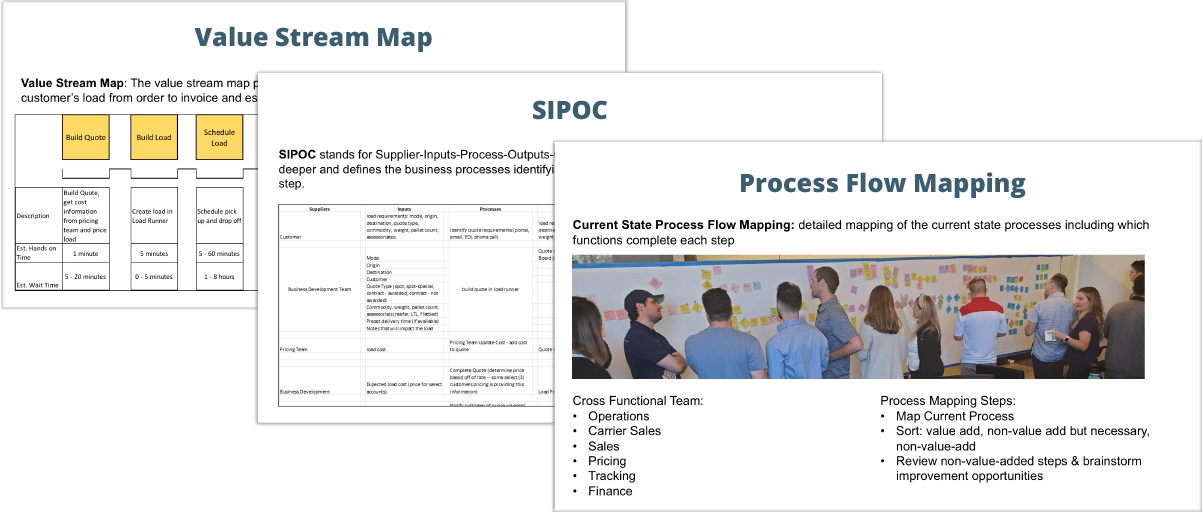
While Lean is a philosophy, it is also a set of very specific tools. If you choose to partner with a Lean consulting firm they should help you choose which tools to apply to specific processes and/or to solve certain problems. These tools include kanban materials management, flow/cellular manufacturing, spaghetti maps, quickchangeover, 5S visual management, process flow mapping, value stream mapping, and mistake proofing. In addition, tools often associated with Six Sigma, such as Pareto analysis and cause-and-effect diagrams, must be included in the toolkit. To help your team use these tools, you should provide Lean education, including a Lean overview for everyone in your company as well as Lean Champion Training for the people leading your Lean transformation.
Lean Implementation
Lean can be implemented in a number of different formats, but they all include the following five steps: 1) Understand the Current State, 2) Identify non-value-added steps, 3) Determine how to eliminate non-value-added steps, 4) Create the Future State, and 5) Build a sustainment plan.
Lean can be implemented as 2 second Lean, which is a very employee-centric version of Lean. Other more traditional methods include a point kaizen (usually 1 day), a kaizen event (usually one week) or a Lean project (one to three months). The choice depends on the scope. Many Lean companies use the kaizen format of one to five day events. These events focus on a small scope and make sure the impact in this small area is large. However, where improvement is needed in a larger work area or a process crosses multiple departments, the Lean project format is better. The project format will ensure that the current state is completely understood and that buy-in exists across all departments for the proposed future state design. 2 Second Lean is used for very small but frequent improvements brainstormed and implemented by your employees and video-taped to show the improvements to everyone and to prove the change was implemented.
Lean Six Sigma
Another powerful process improvement tool is Six Sigma, which traces its roots to statistical process improvement. Six Sigma is focused on problem solving and root cause analysis using graphical and statistical tools. We have found that by combining the two methods into Lean Six Sigma we can help our Lean consulting clients by both streamlining processes and making them more reliable and capable.
Lean Consulting – Assessment
With over 20 years of experience as Lean Consultants we have found that the best way to start the Lean journey and create a culture of continuous improvement is with an Assessment. During the Lean Six Sigma Assessment we will determine the few vital aspects of the current state which are negatively impacting your performance, such as: labor productivity, on-time delivery, quality, material cost and overhead. The Assessment involves interviews with company personnel, a review of the facilities and the analysis of financial and operational data. It is intended as a detailed review, to understand the challenges, the financial impact of these challenges, and which Lean Six Sigma Tools should be used to close these performance gaps. These Lean Six Sigma tools may include:
- Value Stream Mapping
- Process Flow Mapping
- Supplier-Input-Process-Output-Customer (SIPOC)
- Flow Manufacturing
- Kanban Materials Management
- Quickchangeover
- 5S Visual Management
- Pareto Analysis
- Cause & Effect Analysis
- Correlation Analysis
The on-site Assessment includes 2-3 days of interviews and facilities tours. We will continue to work off-site on the Assessment Report and approximately 2-weeks from our initial on-site meeting we will present the Assessment Report findings to management. The report will include the following sections:
- Specific financial impact of sub-optimal business processes
- Proposed solutions and return-on-investment that align with the business strategy
- Timing of Lean projects
- Personnel from the client company who should be on the Lean Team
- Level of consulting services required
Lean Assessment Outline
- Interview key personnel
- Finance
- Sales
- Operations
- Supply Chain
- Engineering
- Customer Service
- Analysis of financial and operational data
- Facility tours
- Determine specific Lean projects and tools to close performance gaps
- Calculate return on investment
- Nominate Lean team members
- Determine Lean implementation timing
- Our promise as Lean Consultants is to prove through our Assessment and implementation, the value of implementing Lean at your company.
View more
Business Process Improvement Consulting
Business Process Improvement (BPI), is a method for evaluating the current processes of the business as a baseline to create business transformation and a streamlined future state. This is done for large and comprehensive business processes, such as order-to-delivery or a supply chain, or more focused processes such as hiring and onboarding. Business process improvement is often implemented by business process consultants and management consultants who work closely with clients. It involves change management and the streamlining of processes in specific departments such as Human Resources, Supply Chain, Information Technology, Program Management, Operations, Customer Services and Finance.
To help you get started on your implementation, Supply Velocity’s business process consultants will conduct an Assessment, evaluating your business based on common examples or symptoms of struggling business processes. All of our consulting services (including business process consulting and supply chain management) use Lean and Six Sigma tools and techniques to achieve fast and sustainable results. In addition, every Supply Velocity business consultant is experienced in facilitating cross-functional teams of subject matter experts and managers to make sure the team does not get bogged down in conflicting ideas and objectives.
Business process problem areas we identify and address include:
- Long order lead times and poor on time delivery
- Complex processes with many steps and hand offs, non-value added steps, waiting, duplication and rework
- Highly reactive organizational culture
- Complex and or misaligned organizational structure with confusing roles and responsibilities
- Lack of standardization
- Poor and inconsistent product or service quality
- Difficult to do business with
- Poor customer service
- Poor internal and external communications
The first step of BPI is Business Process Modeling. This can take from a few weeks to a few months. The steps of Business Process Modeling include:
- Map the current state
- Once complete, the team can clearly agree on the process’ current state and many of the issues plaguing the process
- Sort the map
- The map is marked to identify and highlight non-value-added steps within the process
- Brainstorm ideas to eliminate non-value-added steps
- Prioritize ideas
- Benefit versus Difficulty-to-Implement
- Design the future state map
- Create an implementation and roll-out plan
After Business Process Improvement is implemented you must sustain the gains. This is key to true business transformation and a focus of all of our consulting services. Sustainment requires measuring the performance of processes through Balanced Scorecards and monthly Scorecard reviews. Streamlined processes combined with a monthly/weekly cadence of performance measurement review and action plans creates a virtuous cycle of continuous process improvement.
Business Process Management can help your company meet internal goals and metrics including:
- Greater capacity and throughput
- Improved labor productivity
- Less rework and reduced scrap
Equally important they can help your company meet external customer requirements such as:
- On-time delivery
- Improved quality
- Easy to do business with
Business Process Improvement Assessment
Sometimes companies and employees feel trapped in a poor performance rut that they feel unable to escape. Often this is due more to poorly designed processes than employee performance. Processes are the heart of every organization, but as companies, products and marketplaces become more complex, the demands and expectations of processes become greater and they often fail to effectively meet the company’s or customers’ needs. Personnel are usually aware of problems with their business processes, but they often don’t understand the root causes or the full extent of the issues and their daily work demands don’t provide an opportunity to make the necessary changes. For the company and personnel, it can be a classic example of not being able to “see the forest for the trees.”
Supply Velocity’s Assessment is one of our most popular consulting services. It includes a targeted assessment of the business’ core processes, interviews with personnel, review of the facility and analysis of operational data. We will talk with all functional areas including Operations, Supply Chain, Finance, Information Technology, Human Resources, Program Management and others. Our business process consultants develop a list of prioritized improvement recommendations that are supported by data and observations, and provide a general framework or roadmap for implementation details, timing, requirements and return-on-investment.
Our clients benefit from the Assessment by the identification of Business Process Improvement opportunities from someone not mired down in day-to-day activities.
Consider the following data regarding our Assessments:
- 90% of our new clients choose to have an Assessment
- 80% of Assessments result in using Supply Velocity for implementation of the plan
- Clients invite us back for an average of 4 more projects
- 95% of our sales come from referral
Typically, an Assessment is a 2 to 4 day process involving:
- Interviews with key personnel (executives, managers and individual contributors)
- Analyzing financial and operational data
- Facility tours and direct observation
The onsite portion of the Assessment is swift and hands-on. Our business process consultants engage with your workforce to ensure they are involved and comfortable. We use these interactions to recommend key personnel to be a part of the teams that will support and drive the Assessment’s project recommendations.
History of Business Process Improvement
The methodology for Business Process Improvement has built up over decades starting with the quality revolution that began after WW2 and including:
- Quality revolution in Japan driven by Dr. Juran and Dr. Deming, circa 1950
- Toyota develops Toyota Production System (TPS), 1950’s to 1970’s
- Six Sigma approach developed at Motorola, 1980’s
- Business Process Reengineering the Corporation or BPM by Hammer and Champy, 1990’s
- Jack Welch of GE adopts Six Sigma, late 1990’s
- Rapid growth of Lean & Six Sigma in manufacturing, 1990’s through 2000’s
- Growth of Lean & Six Sigma in service, 2000 – today
Variations include Business Process Reengineering (BPR) or Business Process Management (BPM). As the change management scope increases, Business Process Management looks at an entire business process to create a workflow that is more effective, efficient and capable for adapting to new market demands. Implementation will likely require more formal project management for successful execution.
View more
Execute Your Sales & Operations Plan
Do sales forecast “misses” cause Operations and Supply Chain to make last minute changes to plans and schedules? Does your decision-making process lack alignment between key functional areas? Do these ripple effects negatively impact sales, supply chain and financial performance? If you struggle to turn your sales forecast into a reality because operations, supply chain, sales and finance are not aligned, then you need to consider Sales and Operations Planning (S&OP). Sales & Operations Planning is a coordinated planning process that includes demand planning, supply chain planning and financial planning to support decision-making. In short, it involves business planning across functional areas to improve profitability, on-time delivery, and other metrics by breaking down silos and coordinating the business.
Sales and Operations Planning has often been associated with manufacturing; however, this considerably limits its use and usefulness. Any company with resource constraints can use the S&OP process. Service firms with specialized human resources and distributors managing inventory are some of the most effective users.
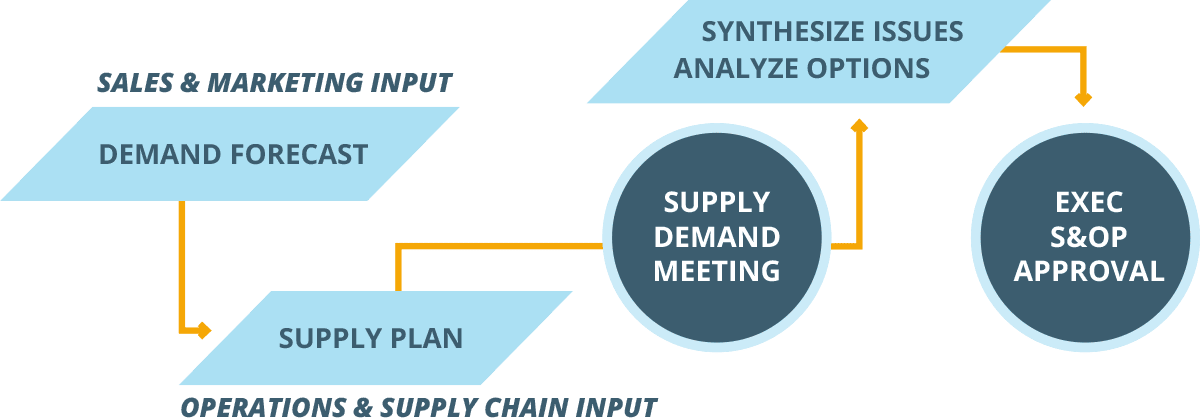
To help you get started developing and implementing your S&OP process, Supply Velocity’s sales and operations planning consultants will conduct an Assessment. We will evaluate your business based on common examples or symptoms of ineffective planning processes. Often during the Assessment we will discover necessary pre-S&OP process development work – for example inventory management might require some improvement to support supply chain planning or your production plan. The deliverable of an S&OP Process Assessment is a detailed implementation plan and pre-S&OP work required to ensure success.
Implementing Sales and Operations Planning:
- Start with a pilot using only one product family and a core team of stakeholders
- Define your product families based on: product characteristics, production process, market-segment, distribution channel
- Limit to 9 product families for the entire company if possible
- Determine unit-of-measure (UOM): each, case, pounds, gallons, pallets, truckloads
- Determine how to measure your capacity (for the operations plan): labor hours, machine hours, production space, warehouse pallet positions, dock doors
- Decide on your time fences and how far in the future you will plan (forecast) internal operations and your supply chain: production lead-time, average supplier lead-time, longest critical supplier lead-time
- Create your S&OP meeting spreadsheet, tracking forecast, actuals, and available to promise
Sales and Operations Planning – Timing
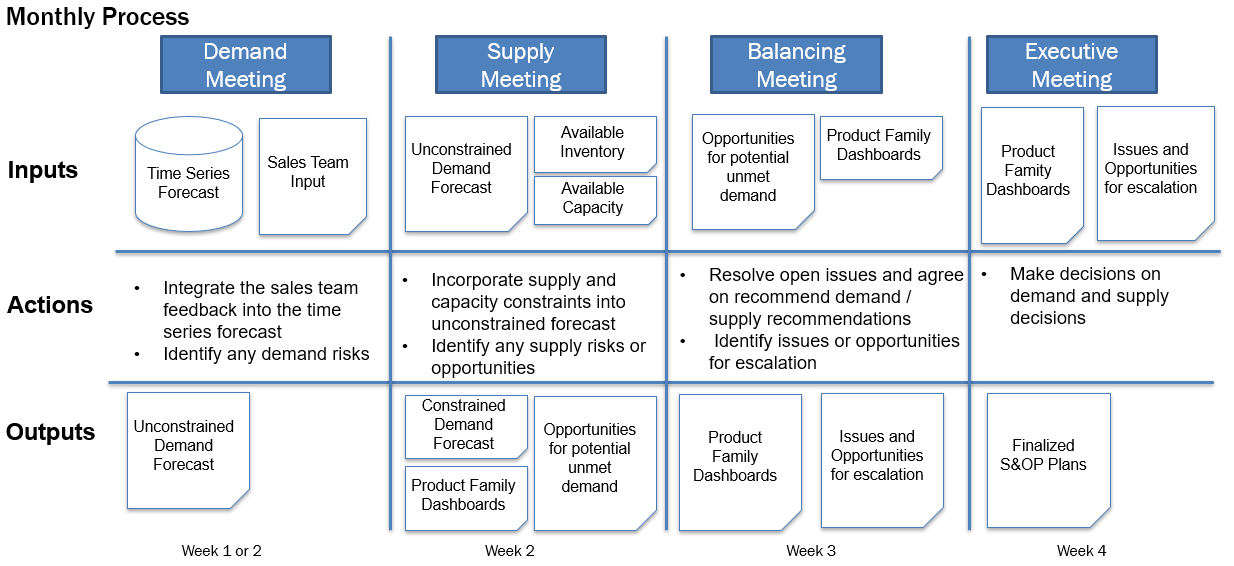
The monthly S&OP Process includes four distinct S&OP meetings as pictured above.
- Demand Planning Meeting: this meeting is typically led by the sales team using sales forecasts, marketing plans and / or sales planning to determine future demand. Automating these processes reduces the effort of data gathering and ensures consistency over time. We recommend combining a statistical forecast with sales representative input on specific customer demand information to improve forecast accuracy. The output from demand planning is an unconstrained demand forecast. New product development and timing are also an important consideration when forecasting demand.
- Supply Planning Meeting: this meeting is led by the operations team and uses the unconstrained demand forecast and key KPIs such as forecast accuracy and forecast bias as key inputs. Available inventory, resource and production capacity will be integrated with the unconstrained demand forecast. The output from this meeting will be constrained sales forecasts, aggregate product family dashboards, and opportunities to fulfill potential unmet demand. These opportunities will be reviewed and discussed in the following two meetings.
- Balancing Meeting: this meeting brings together the demand planning and supply planning teams to resolve any open issues and identify opportunities for escalation to the Executive S&OP Meeting. The teams will leave this meeting prepared to present to the executive team. The key output is the data and analysis including any critical KPIs to support decision-making by the executive team. These decisions may be investing in inventory to win an order, dealing with supply disruptions, moving production to fill in demand gaps or accelerating (delaying) new product introductions.
- Executive S&OP Meeting: this is the final sales and operations planning meeting each month. The teams will present the demand and supply plans as well as any issues or opportunities that arose during the monthly process to the executive team. The purpose of this meeting is not review, it is decision-making. At the end of this meeting there will be a clear path forward on how the company will execute the plan in the short and medium term. Additional strategic plans focusing on the long-term gaps may also be decided.
Buy-in, Buy-in, Buy-in
A successful sales & operations planning process requires collaboration across all business units and functions. If your executive team does not see this process as critical to executing your sales, operations, and financial plan, it will die. They must participate in every meeting. If monthly is too frequent, use quarterly S&OP meetings. When a S&OP process becomes a core part of your business, you can use it to plan for new products, adjust pricing based on market conditions, and achieve cross-functional collaboration.
S&OP and Supply Chain Management
Another important consideration of the S&OP process is the integration of supply chain management. If you are not using sales and operations planning, then the center of your supply chain (your company) will be out-of-balance. If your company is not aligned, how can your supply chain (suppliers and your customers) be aligned? A functioning S&OP process creates the foundation for supply chain management. It mitigates disruptions because not only does forecasting allow you to plan for known variability, but some disruptions are created by a lack of a cross functional supply chain planning process. By creating an S&OP Plan you can ensure procurement’s inventory planning, finances financial planning and the overall supply chain plan accounts for the sales groups forecasts.
View more
Supply Chain Management
For over 20 years Supply Velocity has focused on Supply Chain Management Consulting. We have helped hundreds of firms plan and implement their supply chain strategy. While the term Supply Chain Management has been around since the early 1990’s, its meaning has not always been clear. Some people think it is another name for purchasing; others confuse it with logistics. Our definition of Supply Chain Management (SCM) is:
The coordination and management of materials, information and money from suppliers’ suppliers, suppliers, your firm, customers, and customers’ customers to provide great service for customers and profitably grow sales.
Our Supply Chain Management consulting services focus on helping clients make decisions that can improve the performance of their firm, and their supply chain. These include qualitative and quantitative supply chain decisions. Unlike many supply chain consulting firms, we blend Lean Six Sigma methods into all of our consulting services. Therefore, we are continually looking in the supply chain to identify and eliminate waste and solve difficult problems. This makes supply chain management an aspect of your Lean journey of continuous improvement.
Aspects of supply chain strategy and the supply chain services provided by our consulting firm include:
- Aligning internal functional departments around serving customers, managing suppliers, and collaborating with both
- Determining which customers and suppliers should be involved in an active collaboration program including collaborative planning, forecasting and replenishment (CPFR), sales and operations planning (S&OP), sharing inventory data and new product development
- Creating processes to integrate suppliers into planning, inventory management and new product development
- Integrating information technology into supply chain processes
- Understanding the level of flexibility, resilience, and agility to build into your supply chain to effectively manage supply chain risk
- Designing your supply chain network, including warehouses and factory locations
- Mitigating the Bullwhip Effect
- Evaluating when economies-of-scale are advantageous to costs and customer service
- Choosing the transportation mode and routing that optimizes costs and customer service.
- Deciding the supply chain performance measures for your firm, your suppliers and even your customers
Assessment of your Supply Chain Strategy and Processes
The first step of creating your Supply Chain Strategy and streamlining supply chain processes is to conduct an Assessment. In the 20+ years we have been providing supply chain consulting services we have honed a fast and effective Assessment. We accomplish in a few days what can take weeks for other consulting firms.
Supply Velocity’s Clients benefit from this Assessment by the identification of all Supply Chain Optimization and Supply Chain Analysis opportunities. The Assessment provides a road map for organizational improvements that the client can use on their own, or we can assist and facilitate the development and implementation of the supply chain strategy. Improvements we facilitate often involve the use of Lean Six Sigma to support the streamlining of processes.
Supply Chain Optimization and Supply Chain Analysis are two important, but complimentary methodologies for profitably growing sales through great customer service and disciplined cost management.
Supply Chain Optimization is the evaluation of tradeoffs in your supply chain, including delivery times, inventory availability, transportation costs, facility costs, inventory investment and which suppliers to purchase from – all to find the highest service and lowest cost supply chain design. These design decisions include: 1) the number and location of your factories and/or warehouses, 2) the level of your inventory investment (raw materials, work-in-process and finished goods, 3) the choice of your transportation mode and design of your routing system, and 4) your strategic sourcing decisions. Supply chain optimization is often a component of supply chain strategy.
Supply Chain Analysis involves a comprehensive review of your data to find unseen patterns in demand and cost data. We use various statistical modeling and data analytics tools to determine where cost-reduction and service improvement opportunities may exist. In addition, we combine these analytics with supply chain management best practices including mitigating the Bullwhip Effect, supply chain collaboration, product development, strategic – tactical – operational supply chain decisions, global supply chain management, supply chain risk mitigation, choosing the best supply chain design for your products and understanding the importance of information technology in implementing supply chain management. Supply chain analysis supports supply chain optimization.
Supply Chain Management Assessment Timing & Summary
An Assessment is a 2 – 4 day process involving 1) interviews with key personnel (executives, managers and individual contributors), 2) analyzing financial and operational data, and 3) facility tours.
Supply Chain Management Assessment Outline
- Interview key personnel
- Finance
- Sales
- Operations
- Supply Chain
- Purchasing
- Inventory management
- Logistics
- Engineering
- Customer Service
- Analysis of financial and operational data
- Facility tours
- Evaluate key improvements in the development of your Supply Chain Strategy
- Supply Chain Optimization opportunities
- Supply Chain Analysis opportunities
- Integrating Supply Chain Management Best Practices
- Calculate return on investment from implementation
- Determine team members and timing
View more
Performance Measurement
A survey of businesses posted on LinkedIn found that 52% never or rarely developed and used performance measurement or key performance indicators (KPIs) to evaluate the success or failure of business processes. This is a critical gap because KPIs provide the feedback loop for business to drive business strategy and a profitable bottom line. It is key for effective business performance and project management because it provides quantifiable performance data as feedback for decision-making and driving performance improvement.
In large complex organizations, converting business strategy into effective short-term tactical execution can be difficult. An effective Performance Management System, with a few key performance indicators reduces execution ambiguity and drives accountability. Used broadly and consistently across the company, Performance Measurement helps create alignment and drive improved organizational performance across functional areas so business strategy and departmental goals do not conflict. For companies that struggle with organizational alignment issues, implementing Performance Measurement in conjunction with organizational structure change management is highly effective.
At Supply Velocity, Performance Measurement is one of our fundamental consulting services, and is included with most continuous improvement (CI), business strategy and change management projects. We also apply it to our own consulting firm and to all consulting service lines. When we begin a consulting project, we benchmark our client’s business performance prior to initiating our consulting services. Post implementation we assess the effectiveness of our consulting services by reviewing performance data with benchmarks. We use Key Performance Indicator feedback to inform decision-making and help our clients attain the desired level of operational performance improvement and customer satisfaction.
Helping our clients implement Performance Measurement in conjunction with other consulting projects is our preferred business model. The goal of our consulting service is to make the Performance Measurement Process simple and easy to implement. Our philosophy is that “few measures in the hands of the many is more powerful than many measures in the hands of the few.”
Implementing Performance Measurement will help companies that are profitable as a foundation to achieve the next level of performance improvement. Having clear balanced performance scorecards is the way to implement continuous improvement in your business strategy. For companies that are struggling, the transformation is simple, rapid and dramatic. Performance Management is effective across all industries including manufacturing, professional services, distribution, retail, non-profit and government, and many different types of supply chains.
Performance Measurement Assessment
Do you feel like your workforce is not aligned, focused or effective? Is business performance suffering? Is decision-making slow? In the 20+ years we have been proving performance improvement consulting services, we have seen executives blame their people, but not provide quantitative feedback on performance. Without this feedback your people are working in the dark. They get through the day, week or month, but don’t know if they are performing great or poorly, except for verbal “good job” when profits are strong, or “you’ve got to do better” if financial results are suffering.
Symptoms of vague Performance Measurement Systems are:
- You created a business strategy, but it remains a plan that is never implemented
- Performance improvement is ad hoc
- Sales and operations are working at cross-purposes
- Employee problems, including high absenteeism and turnover
- New products don’t meet sales expectations
- Customer are not loyal and complaints are high
- Project management practices are based on gut-feel not data
Our consulting firm’s Performance Management Assessment provides a targeted assessment of the businesses’ performance versus strategic and tactical goals. The Assessment contrasts perceived performance throughout the organization with available performance data and reports. The Assessment also includes change management, alignment, internal communications, standardization and consistency. The Performance Measurement Assessment determines if key performance indicators (KPIs) are in place and effective. We then provide a road map for developing and executing this system using hierarchical Performance Scorecards.
Over the years, we have honed one of the most effective, swift and cost-effective Assessments available. The recommendations are supported by performance data and observations and provide a general framework for the implementation steps, timing, requirements and finances.
Typically, an Assessment is a two-day process involving 1) interviews with key personnel (executives, managers and individual contributors), 2) analyzing financial and operational performance data, and 3) facility tours and direct observation. The onsite portion of the Assessment is very hands-on. We work directly with personnel to ensure they are involved and made comfortable with the overall process.
Things we look for during the Assessment:
- How are key performance indicators used in the organization?
- How well are measures understood and how accessible are the data?
- What meetings and venues are used for communications, alignment and accountability?
- Does poor performance lead to action items to close the gap
- How consistently understood are high level companywide Performance Measures across the organization?
- How well is the company performing versus its Performance Measures?
- Do measures align and complement across departments?
- Are measures leading or lagging?
- Do key Performance Measures include both internal (voice of the business) and external (voice of the customer) critical requirements?
Even companies that invest effort to develop performance data and balanced scorecards are sometimes surprised their system is not as effective as it could be. Supply Velocity works closely and collaboratively with your organization to get an accurate Performance Measurement Assessment and then we show you the path to making it effective.
View more
Expert Six Sigma Consultants
The fundamental objective of the Six Sigma methodology is the implementation of a measurement-based strategy that focuses on process improvement and variation reduction. Six Sigma includes data driven tools and techniques to help practitioners to objectively understand and quantify how their processes perform. Six Sigma is about letting the data tell the true story and leading the practitioner to the “root cause” to solve complex problems that have multiple “factors” with varying degrees of impact on performance.
Six Sigma Methodology (DMAIC, DMADV, DFSS)
Six Sigma is a rigorous problem solving methodology that uses well-defined progression phases of Define, Measure, Analyze, Improve and Control, popularly known by the acronym, DMAIC. Define is problem definition, making sure you are solving the correct problem. Measure is gathering data that helps explain the problem. Analyze is reviewing the data to find patterns that lead to the root cause. Improve is making changes in the process based on the analysis. Control is achieved by putting process steps in place to ensure improvements are sustained. For the design and development of new systems or processes, there is a similarly defined progression of phases known as Define, Measure, Analyze, Design and Verify (DMADV) or also referred to as Design For Six Sigma (DFSS).
Six Sigma Principles (reduction in variation, root cause analysis)
The Six Sigma methodology was originally implemented in the semiconductor and electronics industry to reduce variation in manufacturing processes. While the tools have been applied well beyond manufacturing the principles have held, that improvement in quality comes from the reduction in variation of your process.
Master Black Belt, Black Belt, Green Belt, Yellow Belt
The organizations who packaged and marketed the different problem solving and statistical tools also created a smart name for the Six Sigma training they provided. The associated belts represent tiers of capability that can be achieved. Master Black belts can teach all of the tools used in the DMAIC process. Typically Six Sigma consultants are master black belts. To achieve this level you need to pass the Six Sigma certification requirements of a recognized organization or company, and have taught black belt, green belt and yellow belt classes. The other “belts” are different tiers of education. Black belt classes often take 4 weeks of education (16 days) spread out over a few months. People leading projects should be Six Sigma black belts. Green belt classes are often 6 days of classes. Green belts can support projects, filling in for the Six Sigma black belt as needed. Yellow belt is an overview training that can be completed in 1 – 2 days. Lean Six Sigma project team members should have yellow belt training.
Six Sigma Problem Solving Tools
Six Sigma uses a variety of statistical and graphical tools in the DMAIC process. These include visualization tools such as fishbone (cause & effect) diagrams, scatter plots, bar charts, pareto charts and more. In addition, rigorous statistical tools are used to make comparisons of data that go beyond intuition. These tools include hypothesis testing, experimental design and regression.
Lean Six sigma
Six Sigma is often used along with Lean as a holistic process improvement / continuous improvement method and is called Lean Six Sigma. Lean is comprised of a set of tools for identifying and eliminating non-value-added steps in a process. Lean tools include value stream mapping, process flow mapping, kanban/flow manufacturing, 5S visual management, quickchangeover and mistake-proofing. Lean is very good at evaluating the Value Stream for speed and efficiency while Six Sigma is good at understanding the root cause of problems within the Value Stream.
By bringing together these two methods, Lean Six Sigma provides practitioners and Six Sigma consultants the best tool to work on different problems and processes. It could be that there is variation in the process but to sustain the improvements requires 5S. Or we may be streamlining a process using process flow mapping but we find a low first-pass-yield at a certain step that requires root cause analysis. Viewing process improvement / continuous improvement holistically, results in more robust and sustainable improvements.
Six Sigma Manufacturing
Six Sigma was initially used to reduce variation and improve quality in manufacturing and often you will hear the term Six Sigma Manufacturing. Within the manufacturing process each step is analyzed using statistical and graphical tools to understand its process capability and if it can meet customer expectations. The term Six Sigma stands for a process that can “fit” 6 standard deviations between the average value of the process and customers’ specification limits. This process would produce only 3 – 4 defects per million opportunity (DPMO).
However, Lean Six Sigma can be used in many industries including financial services (back office order processing), healthcare (health outcomes from procedures) and distribution (order fill rate, mis-ships). In fact, these industries, with very high transaction volume, can actually be a better fit for the DMAIC process.
Process Improvement and Continuous Improvement
There is often confusion between the similarity and difference of process improvement and continuous improvement, and where Lean Six Sigma consulting fits. Process improvement is the action of using Lean Six Sigma to make improvements to processes and solve difficult process problems. (Lean is often called Lean Process Improvement). Continuous improvement is the ongoing journey a company (or individual) will undertake to endlessly make “continuous or incremental” improvements to processes, people and functions in their organization. If you have heard of Kaizen Events, the word, Kaizen, literally means “change is good” but it’s spirit is to make continuous improvement in your organization. Lean Six Sigma is one of many methods to support continuous improvement.
Lean Six Sigma Consulting
Supply Velocity has over 20 years of experience as Lean Six Sigma consultants. We have implemented hundreds of Lean Six Sigma projects and have led thousands of Lean and Six Sigma training workshops. We have two master black belts on our staff.
Our key differentiator is our focus on implementation with supporting education. We take our clients through the DMAIC process in a practical way that leads to knowledgeable teams and sustainable results. In addition, we have implemented Lean Six Sigma in many different industries including service, retail, distribution and manufacturing. When choosing a Lean Six Sigma consulting firm you should make sure there is a good personality fit and that the firm balances implementation and training in order to help make Lean Six Sigma and continuous improvement become a part of your company’s culture. We believe the best Lean Six Sigma consultants will want to educate people but also make sure that real improvements are achieved and sustainable.
View more
Trainings, Webinars & Workshops
Education is a key part of our consulting approach and we offer various training options.
We offer live, in-person, workshops on Lean, Six Sigma, Performance Scorecards, Supply Chain Management, Inventory Optimization and Management, and Sales and Operations Planning. Workshops include in-class exercises, simulations and hands-on interactive discussions. They typically have 15 to 20 participants and are conducted in person.
To support geographically dispersed organizations, we offer these same workshops as live virtual sessions. These are typically done is 90-minute modules, with all of the exercises and interactive discussions of our in-person workshops. Sessions are recorded so that anyone who misses a session can easily catch up.
Any of these workshops can be customized, focusing on specific tools or topical areas and going very deep into these subjects. Or, we can cover these topics more broadly and higher level for general understanding. We also provide topical customized public speaking for events and conventions.
Some of the workshops are offered publicly in a virtual format. When the workshops are scheduled, we maintain a calendar of public training events on our website. Any of them can be provided as private client training as in-person or in the virtual format.
Our team is also proud to present year-round paid workshop sessions and free case study webinars to help “sharpen your saw” in supply chain and operations management.
View more